
From Audit Risk to Operational Confidence: Modernizing Right-of-Way Management
Overview
A growing right-of-way (ROW) department within a national engineering firm faced increasing audit exposure, complex federally funded compliance requirements, and operational strain caused by highly variable parcel volumes. Without a structured system in place, the team relied on shared drives and disconnected documentation processes that were not built for ROW’s legal rigor.
They needed a purpose-built solution that could:
- Protect against audit and legal exposure
- Centralize documentation and compliance tracking
- Support highly variable project sizes
- Enable field-to-office documentation in real time
- Align with budget realities
- Scale as the department grows
High Legal Exposure in a Highly Variable Environment
Right-of-way work operates under intense regulatory scrutiny—particularly on federally and state-funded projects—where documentation must be complete, defensible, and audit-ready at every stage. As the team explained, “Right-of-way is as legally based as any line of business that we have within the company.” With oversight considered inevitable, the stakes were clear: “If anybody’s going to get audited or need a paper trail of when we did it, why we did it, who we did it with, it’s going to be right-of-way.”
At the same time, project scope varied dramatically. “One might be one parcel, the next project might be 500 parcels of land. None of them are the same.” This combination of high legal exposure and extreme variability created a complex operational challenge—requiring processes that were both rigorously compliant and flexible enough to scale from single-parcel acquisitions to large, multi-parcel programs without losing documentation integrity or control.
Centralized Data: From Fragmented Files to Structured Compliance
Right-of-way operations require a level of documentation, parcel tracking, landowner communication, and regulatory compliance that standard engineering project systems simply aren’t designed to handle. As the team described, “Right-of-way is very unique on how it operates compared to a normal engineer’s workflow or systems that they would use.” Shared drives and generic engineering tools resulted in disconnected files, inconsistent tracking, and a reliance on manual organization.
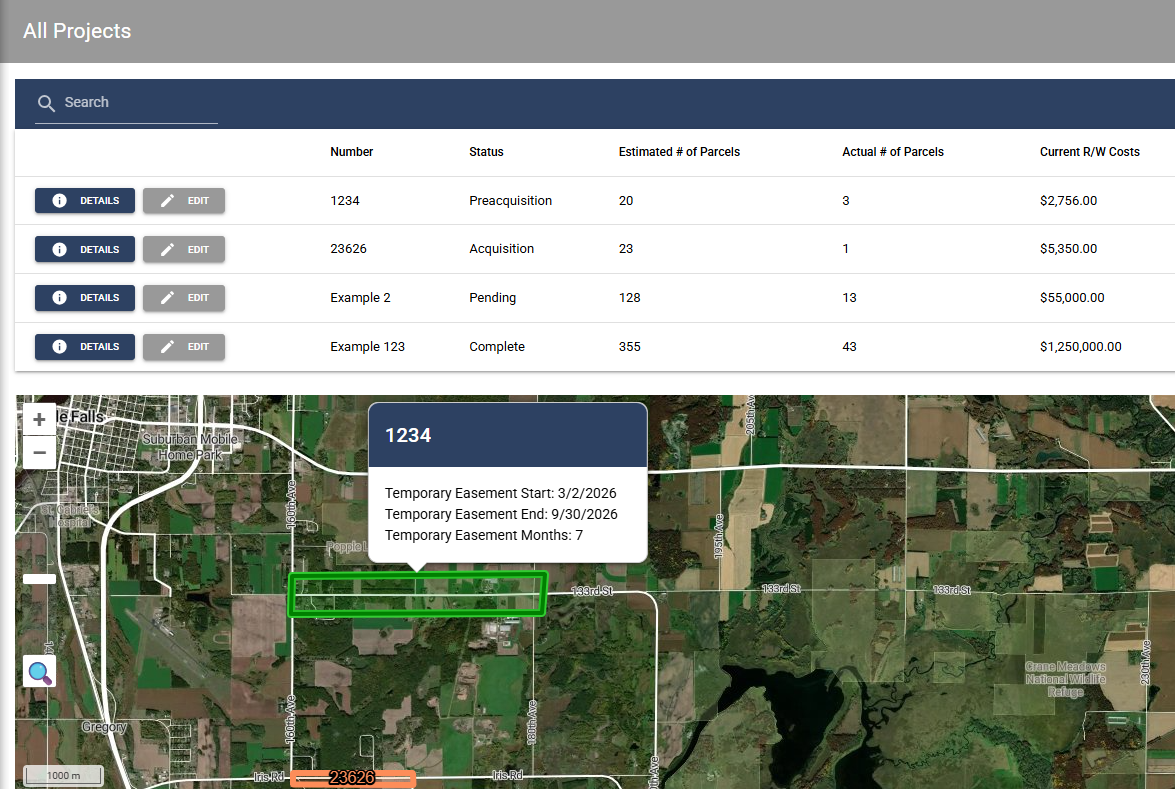
The turning point came with the realization that storage alone was not enough. The team needed centralized data management with built-in oversight and compliance layering. “Centralized data management… mainly enhanced compliance, just another spot that’s keeping track of everything.” Rather than relying solely on internal folders, they established a structured, system-driven environment that acted as a parallel control layer. “Not only do we have all of our ducks in a row internally, we have this side set of information within this software that kind of accompanies both what we have internally and on RTVision.”
By moving from fragmented shared drives to a purpose-built, centralized platform, the organization gained more than organization—they gained defensibility, redundancy, and structured compliance controls. The result was a single, authoritative source of truth that supports both daily execution and audit-readiness, ensuring right-of-way processes are organized, transparent, and legally defensible.
Scalable Growth Without Enterprise Barriers
At the outset, the department was operating at “ground zero,” building its right-of-way program from the ground up. They needed a system that could scale with them—not one that required enterprise-level investment before the program could be used.
Beyond budget, flexibility was critical. They valued a platform that could evolve alongside their program, positioning their department for sustainable, long-term scalability. What they implemented on day one met their needs, while creating a foundation to expand program complexity over time.
Results & Business Impact
✔ Stronger Audit Readiness
Complete documentation trails for every parcel, communication, and compliance milestone.
✔ Reduced Legal Exposure
Structured workflows ensure federally funded requirements are followed “to the T.”
✔ Operational Efficiency
Streamlined processes across small and large projects reduce administrative burden.
✔ Real-Time Field Documentation
Landowner meetings and conversations are documented instantly, not retroactively.
✔ Executive Confidence
Budget alignment enabled approval while maintaining enterprise-grade control.
✔ Long-Term Scalability
A foundation built to grow alongside the department’s expansion.
Key Takeaways
- Right-of-way is legally intensive and audit-prone—documentation must be defensible.
- Generic engineering systems cannot support ROW complexity.
- Centralization is about compliance control, not just file storage.
- Mobile access is critical for field-driven workflows.
- Flexible SaaS partnerships outperform rigid enterprise deployments.
- Budget alignment accelerates executive buy-in.
When right-of-way carries the highest audit exposure in the organization, “organized enough” is not enough.
A structured, scalable, and defensible system isn’t a convenience—it’s a risk management strategy.