
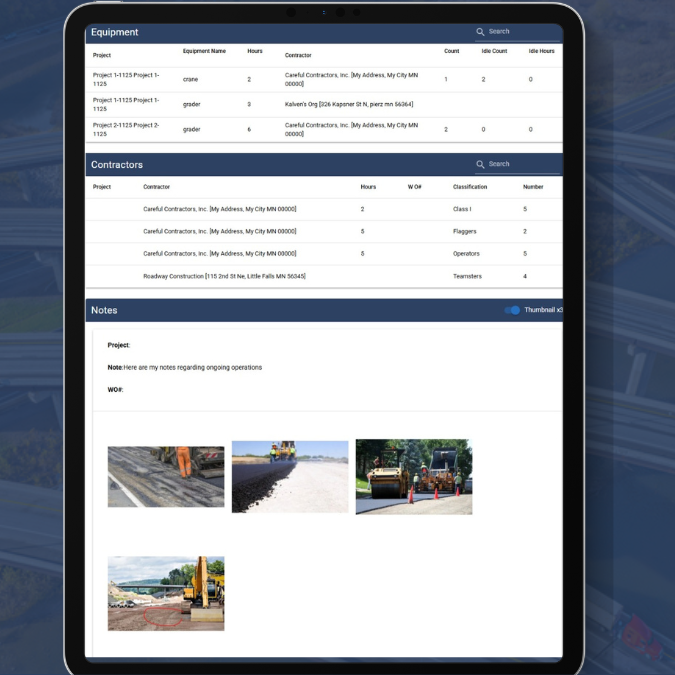
Construction Inspector Daily Reports: Faster, Smarter Reporting
Inspector Daily Reports (IDR), or Daily Work Reports (DWR) are one of the most critical records in any construction project. They document daily progress, field conditions, weather impacts, quantities installed, workforce activity, and compliance observations. When managed properly, they form the backbone of project transparency and defensibility.
Yet in many agencies, Daily Reports are still completed using manual forms, spreadsheets, or delayed uploads from the field. This creates gaps in documentation, inconsistencies in data, and a disconnect between field observations and the broader project record. Over time, these gaps can complicate pay estimates, delay closeout, and make it difficult to reconstruct what happened on a project months, or years, later.
A Field-First Approach to Daily Reporting
With OneOffice, inspectors complete Daily Reports directly in the field using a mobile-friendly interface. Work performed, quantities installed, site conditions, equipment, materials, workforce counts, and issues can all be recorded at the time of inspection when information is most accurate and verifiable.
Inspectors can:
- Capture and attach photos in real time
- Record detailed notes and observations
- Document weather and site conditions
- Track installed quantities and percent complete
- Log issues, deficiencies, and corrective actions
Because reporting happens as work is performed, agencies reduce reliance on memory, eliminate redundant data entry, and improve overall data accuracy.
Geographic Context Built In
Daily Reports in OneOffice are not isolated documents, they are connected to project location data. Photos and field notes can be stored with geographic context, allowing observations to be associated with specific segments, parcels, or assets.
This map-driven approach provides:
- Clear visual documentation of where work occurred
- Stronger defensibility during audits or disputes
- Easier coordination between field and office staff
- Improved long-term asset traceability
By connecting documentation to location, agencies create a clearer and more actionable project record.
Seamless Integration with Project Workflows
Field data collected through Daily Reports flows directly into related project records. Quantities captured in the field can support pay estimates. Observations can inform schedule updates. Documentation becomes part of the permanent project history.
This continuity ensures:
- Alignment between field activity and office workflows
- Reduced rework during pay estimate preparation
- Stronger audit trails and compliance support
- Fewer surprises during project closeout
Rather than managing disconnected systems or re-entering information, agencies operate from a single, centralized source of truth.
Supporting Construction Delivery and Asset Lifecycle Management
Daily Reports are not just construction records—they are the front end of the asset lifecycle. When documentation, quantities, and field observations are preserved within the broader project system, agencies are better positioned to support long-term maintenance, performance tracking, and future capital planning.
By integrating Daily Reports into the broader OneOffice workflow, agencies can:
- Improve data consistency across projects
- Reduce administrative burden during closeout
- Strengthen compliance and defensibility
- Preserve institutional knowledge
- Enable smoother handoff from construction to asset management
In today’s environment, where transparency, accountability, and long-term infrastructure stewardship matter more than ever, field-driven documentation is not optional. It is foundational.
With OneOffice, Daily Reports become more than a record of the day, they become a connected, auditable, and actionable part of your infrastructure lifecycle.